
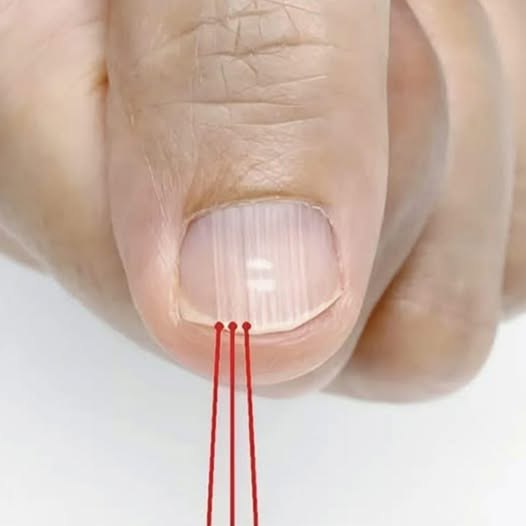
What those vertical lines on your nails really reveal
Those vertical ridges on your fingernails—known medically as longitudinal striations—are incredibly common, especially as we get older. While they can occasionally signal an underlying health issue, they are most often a natural “wrinkle” of the nail bed rather than a cause for alarm.
Here is the breakdown of what those lines are telling you and when you should actually pay attention to them.
1. The “Nail Wrinkle” (Natural Aging)
Just as our skin loses collagen and moisture over time, our nails undergo structural changes. Vertical ridges are frequently just a sign of the nail’s aging process.
- The Cause: As we age, the cell turnover in the nail slows down, and the natural oils that keep the nail plate smooth begin to decrease.
- The Result: The nail plate thins and develops these raised, vertical lines. If your ridges are uniform across all fingers and have appeared gradually over years, this is almost certainly the cause.
2. Chronic Dehydration
Your nails are a reflection of your body’s hydration levels. If you aren’t drinking enough water, the nail matrix (where the nail starts growing) can’t produce a smooth, hydrated plate.
- The Sign: Ridges accompanied by brittle, peeling, or easily broken nails.
- The Fix: Increasing daily water intake and using a topical high-quality cuticle oil containing Jojoba or Vitamin E can often smooth these lines out over several months.
3. Nutrient Deficiencies
In some cases, your nails act as an early warning system for what’s missing from your diet.
- Iron Deficiency (Anemia): This is a frequent culprit. If the ridges are deep and the nail also looks “scooped out” or concave (spoon nails), you should have your iron levels checked.
- B-12 and Zinc: A lack of these essential nutrients can disrupt the protein synthesis required to build a healthy, flat nail surface.
4. Digestive Malabsorption
You might be eating the right nutrients, but your body isn’t absorbing them. Vertical ridges can sometimes be a secondary symptom of gut health issues like Celiac disease or Crohn’s, where the body fails to take in the vitamins necessary for nail growth.
When Should You Be Concerned?
While vertical ridges are usually benign, horizontal ridges (known as Beau’s lines) or specific color changes are different. You should consult a doctor if you notice:
- Horizontal Indentations: These can indicate a past illness, high fever, or systemic stress that temporarily stopped nail growth.
- Sudden Change in Texture: If the ridges appear rapidly rather than over years.
- Discoloration: Especially a dark vertical stripe (brown, black, or blue) under the nail, which can be a sign of subungual melanoma.
Pro Tip: Avoid the temptation to “buff away” deep ridges. Excessive buffing thins the nail plate significantly, making it weak and prone to painful splitting. Instead, use a “ridge-filling” base coat to create a smooth surface for polish.