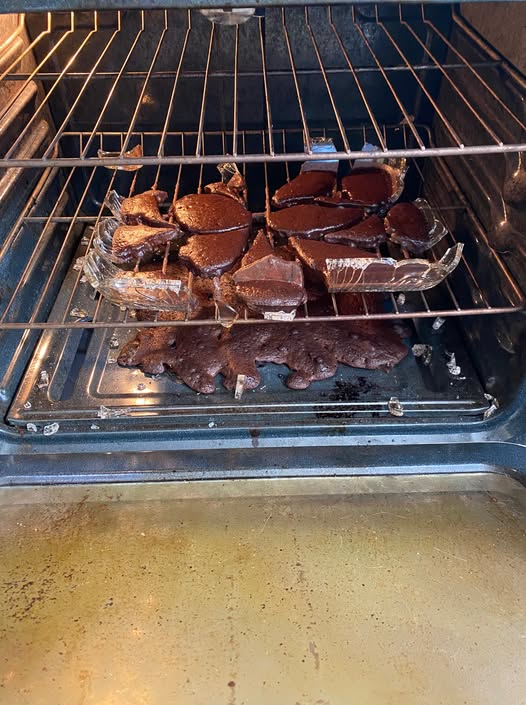
So here’s the story. I mixed up cake batter (from a box mix), put it in a preheated oven. In five minutes I smelled something burning. This is what I saw when I opened the oven. The glass shattered everywhere. The directions say it can be baked in either an aluminum pan or a glass pan. Anyone have an idea why this happened. Yes, the glass pan is pretty old but has been used (successfully) often.
1. Invisible Micro-Cracks
Over years of use, glass develops tiny, invisible scratches from metal spatulas, abrasive sponges, or being stacked in the cupboard. These micro-cracks weaken the structural integrity of the glass. When the pan is placed in a hot oven, the glass expands; if a crack is deep enough, the stress causes it to “spider” and shatter instantly.
2. Radical Temperature Changes
Did the batter go in cold? If the batter was chilled or if the pan was sitting on a very cold countertop before going into the preheated oven, the temperature differential creates “differential expansion.” The outside of the glass heats up and expands faster than the inside, leading to a blowout.
3. The “Old Glass” Factor
If the pan was an older piece of Pyrex, it was likely made of borosilicate glass, which is very resistant to thermal shock. However, if it was made in the last few decades, it might be soda-lime glass (tempered glass). While soda-lime is physically stronger against drops, it is actually more sensitive to rapid temperature changes than the older borosilicate versions.
4. Surface Contact
If the pan was wet on the bottom or if it touched a cold heating element or a damp oven rack, that localized cold spot compared to the 350°F+ air can cause the glass to snap.
Critical Safety Steps Now:
- Do NOT eat any of that cake: Even the parts that look “clean” on the racks likely have microscopic glass shards or “glass dust” on them.
- Let it cool completely: Do not try to clean it while it’s hot. Glass can continue to pop as it cools.
- Vacuum, don’t just sweep: Once cool, use a shop-vac or a vacuum with a hose to get into the crevices of the oven. Tiny shards can ruin your oven’s fan or heating elements if they aren’t removed.
- Check the floor: Glass from an oven explosion often travels further than you’d think through the vents.
For Your Next Bake:
If you want to avoid this anxiety in the future, lightweight aluminum or heavy-duty light-colored metal pans are the way to go. They don’t shatter, they heat up more evenly, and they cool down faster—making them the preferred choice for most professional bakers.